Specification8 min
Riven, honed, polished, sawn: comparing limestone finishes
The same limestone can look and behave very differently depending on how its surface is worked. Here is how the four common finishes actually differ.
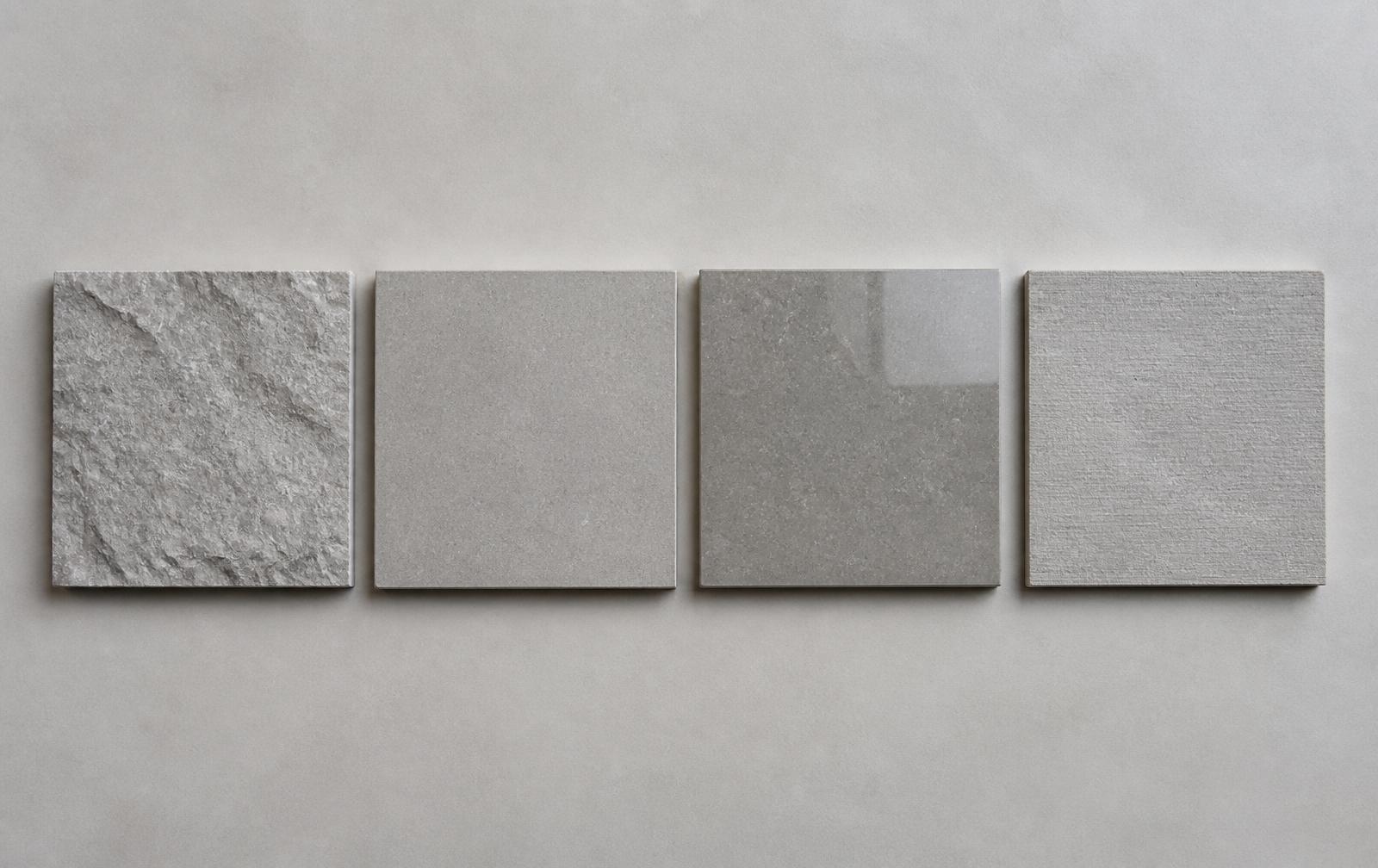
Finish changes the stone more than colour does
Two slabs cut from the same block of limestone can look, feel and perform quite differently depending on how their surface has been worked. Buyers who are new to natural stone often focus on colour first and finish second, but for a working specification it is usually the other way round: the finish decides whether a stone is safe underfoot outside, how it reads in low light, and how much maintenance it will need.
Limestone in particular takes a wide range of finishes well because it is relatively soft and fine-grained compared with granite or hard sandstone, and it splits cleanly along its natural bedding planes. That is why the same quarry bed can leave as riven paving, honed flooring, or a polished feature floor, without changing the underlying material at all.
Riven (natural cleft)
A riven finish is produced by splitting the stone along its natural bed, rather than cutting or grinding the surface flat. The result is an irregular, textured face with slight variation in thickness and surface height from piece to piece. This texture is what gives riven paving good underfoot grip when wet, which is why it is the default choice for external paving, terraces and garden paths across most limestone and sandstone ranges, not just this one.
The trade-off is a less uniform appearance — joint lines and surface texture read more strongly than on a flat-ground finish — and a slightly less even laying surface, which matters more for bedding depth than for finished appearance once grouted.
Honed
Honing grinds the surface flat and smooth without polishing it to a shine, producing a matt, even face with minimal texture. It is the standard choice for internal flooring, because it gives a clean, consistent look without the slip risk that comes with a fully polished surface, and because a matt face tends to show scratching and wear less obviously over time than a glossy one.
Honed limestone is generally not recommended for exposed external paving in a wet climate, since the flatter, smoother surface offers less grip than a riven or textured face. Covered external areas — porches, colonnades, sheltered walkways — are a more defensible middle ground where a honed finish is sometimes used.
Polished
Polishing takes the surface further than honing, using progressively finer abrasives until the stone develops a reflective, glossy face. It deepens colour and brings out the fine detail and any natural fossil inclusions in the limestone, which is why polished floors are often chosen for feature interiors, entrance halls and areas where the stone itself is meant to be a visual statement.
A polished face is also the most slippery finish available on any limestone, wet or dry, and should be treated as an internal-only option. It also wears its polish gradually under heavy foot traffic, particularly in commercial settings, and will usually need periodic re-polishing or maintenance to keep its original sheen — a point worth setting with a client at quotation stage rather than after the floor is down.
Sawn
A sawn face is simply the flat surface left by the cutting blade, without any further grinding or polishing. It has a slightly rougher, more mechanical texture than honed, and visible saw marks are usually still faint but present. Sawn finishes are most often used on hidden faces — the back or bedding face of a slab — or for rustic and budget-conscious applications where the slightly uneven, workshop-fresh look is wanted rather than avoided.
Because it needs no additional processing beyond cutting, a sawn finish is also the starting point every other finish is built from: a slab is sawn first, then honed, polished or, for riven work, split along the bed instead of cut.
A simple way to choose
If the surface will be walked on outside and get wet, start with riven or another heavily textured finish. If it is an internal floor that needs to look clean and consistent without a shine, start with honed. If it is a feature area indoors where appearance matters most and slip risk is controlled by other means (matting, signage, dry conditions), consider polished. Sawn is generally a hidden-face or budget choice rather than a finished floor surface.
Key takeaways
- Riven gives the best wet grip and suits external paving; honed suits internal floors that need a clean matt look; polished suits internal feature floors only; sawn is mostly a hidden or budget face.
- The same block of limestone can be finished four different ways without changing the underlying stone.
- Polished floors need ongoing maintenance to keep their sheen and should not be specified for external or wet areas.
- Match finish to how the area will actually be used before matching it to colour.
More from the journal
Related stones and reading

Not sure which finish suits your project
Quotations available to your nearest port or delivered to your yard, on request.