Specification9 min
Choosing limestone for UK external paving: what actually matters
Frost and wet slip are the two things that decide whether an external limestone floor survives a British winter. Here is what to ask about, in plain terms, before you specify.
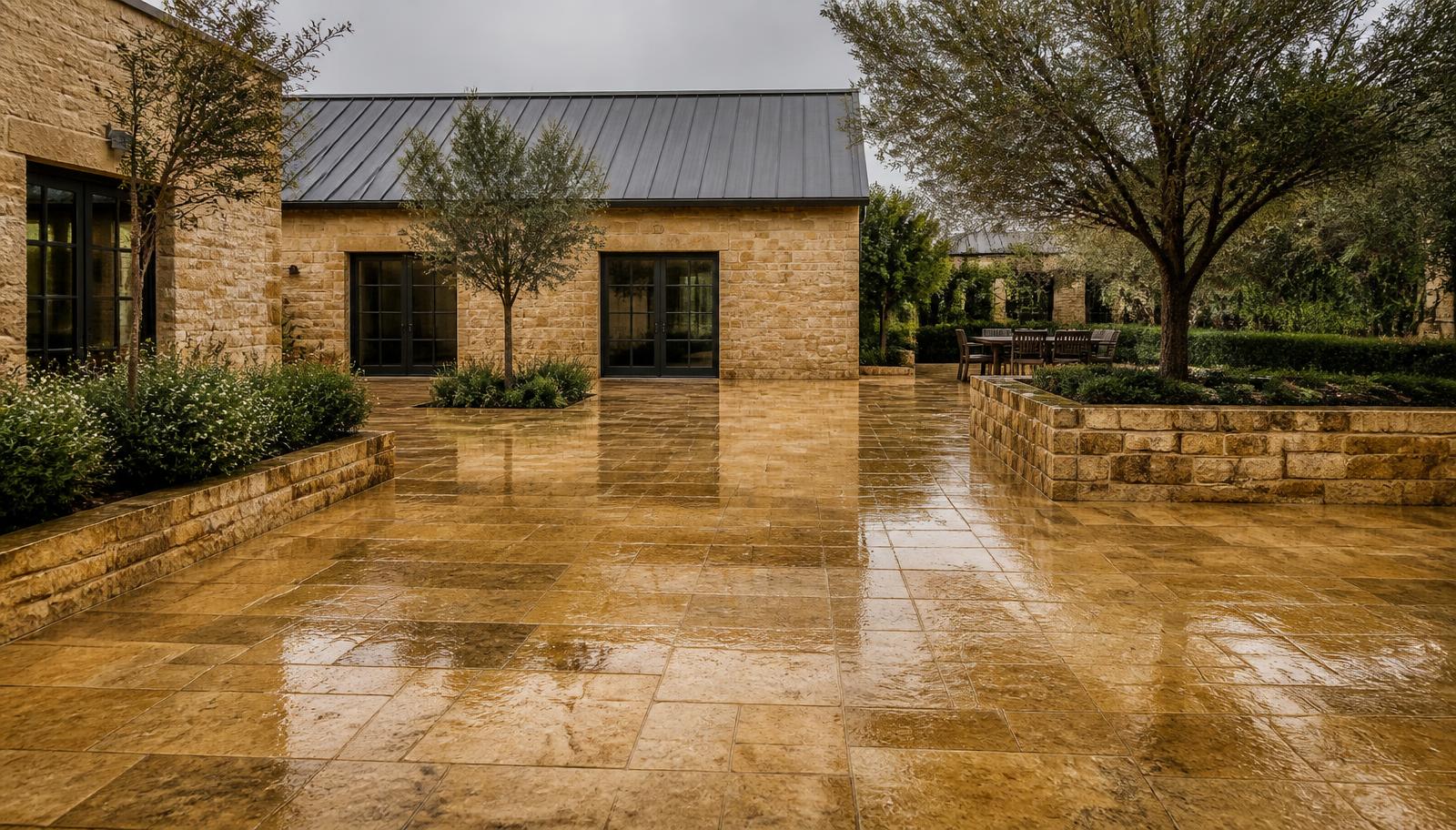
Two questions, one decision
Most enquiries for external limestone paving eventually come down to two practical questions: how will the stone cope with repeated freezing and thawing, and how safe is it underfoot when it is wet. Colour and price tend to get agreed first, but a floor that fails either of these tests is usually lifted within a couple of winters, and it is the merchant who fielded the original enquiry who deals with the fallout, not the quarry the stone came from.
The difficulty is that both properties get discussed loosely in trade conversation, often without reference to the finish actually being supplied or the conditions the stone will sit in. A slip comment or a frost comment that is not tied to a specific finish and a specific exposure is not really usable information — it is a general impression. This piece sets out, in general terms that apply to any dense sedimentary limestone including Shahabad limestone, what actually drives these two behaviours and what a buyer should ask for before committing to an order.
Why frost damages some stone and not others
Frost damage in limestone, in almost every case, starts with water. Limestone is a sedimentary rock with a network of small pores between its mineral grains. Rainwater is drawn into those pores by capillary action, and when the temperature drops below freezing, that trapped water expands by around nine percent as it turns to ice. Repeated over many freeze-thaw cycles, that expansion can open hairline cracks, and eventually cause flaking or spalling at the surface.
This is why porosity and water absorption are the properties worth asking about first, before a headline frost rating. A denser, less porous limestone simply has less free water sitting in it to freeze in the first place, and will generally tolerate a UK winter better than a more porous stone of the same type. Independent laboratory testing to standards such as BS EN 13755 (water absorption) and BS EN 12371 (freeze-thaw resistance) is the recognised way to put a number on this, but a number is only meaningful if it is tied to the specific batch and finish being shipped, not to the stone type in general.
Our own Shahabad limestone range has been independently tested to BS EN 13755 (water absorption) and BS EN 12371 (freeze-thaw resistance) at a UKAS-accredited laboratory, with water absorption typically in the 3.5–4.5% range by mass depending on stone and bed, and no measurable loss of flexural strength after 48 freeze-thaw cycles. Those figures are batch-specific and are confirmed again at each production run rather than assumed to carry forward indefinitely.
Wet slip resistance: why finish matters more than stone type
Slip is the property that gets tested on a real installation if someone falls on it, so it deserves careful handling in a specification. The recognised UK and European approach uses the pendulum test method (BS EN 14231) to produce a wet slip value, sometimes cross-referenced against the German ramp test (DIN 51130), which produces an 'R' rating. Both describe how a surface performs when wet underfoot, using different rigs and different scales.
What is true across almost any stone type, not just limestone, is that finish affects slip resistance more than the underlying mineral does. A riven, natural-cleft face has a textured, irregular surface that gives the foot more to grip. A honed face is flat and even, with much less surface texture, and reads smoother underfoot. A polished face is smoother again, and is generally not appropriate for any external, trafficked, or wet area regardless of the stone beneath it.
That single relationship — texture first, mineral second — is the most useful rule of thumb for a merchant working through a specification with a client: if the area is external, walked on, and likely to get wet, look at riven or a heavily textured finish first, and treat honed or polished as internal-only options unless test data says otherwise.
What a slip figure does not tell you
A slip test is carried out on a laboratory sample in controlled conditions, not on a laid and jointed floor exposed to weather, moss, algae and years of foot traffic. Joint width, fall to drainage, and ongoing maintenance all affect how a floor actually performs, and none of those are captured in a laboratory figure. A specifier who checks a test certificate and stops there has not fully thought the installation through.
It is also worth knowing that slip performance can change over the life of a floor. Textured, riven and shot-blasted finishes tend to hold their grip because there is nothing smooth to wear down. Polished and, over time, honed surfaces can become more slippery as foot traffic gradually burnishes the top layer — one more reason polished finishes are not recommended outdoors.
Matching finish to exposure, in practice
Working through a paving enquiry, three questions come before any stone or finish is chosen. First, is the area purely pedestrian, or does it need to carry occasional vehicle loading, which affects thickness and jointing rather than finish. Second, how exposed is the area to standing water and shade, which affects both slip risk and how quickly algae or moss might establish. Third, what look is the specification actually asking for, since that often narrows the finish choice before the stone colour is even discussed.
As a general rule that applies across limestone types: riven or heavily textured finishes suit exposed external paving, terraces and courtyards. Honed finishes suit covered walkways, porches and internal transitions. Polished finishes belong indoors only. None of this replaces batch-specific test data where it exists, but it is a sound starting point for a conversation with a client before test paperwork is even on the table.
Where a client wants a smoother, more architectural external finish than is sensible from a safety standpoint, the honest answer is to say so in writing rather than let a slip risk go unmentioned. That single line in a quotation has saved plenty of merchants an awkward call after installation.
Key takeaways
- Frost damage is driven by water trapped in pores expanding on freezing — porosity and water absorption are the properties to ask about first.
- Finish affects wet slip resistance more than the underlying stone type — riven and textured faces grip better than honed, and honed grips better than polished.
- A laboratory slip or frost figure only means something when it is tied to the specific batch and finish being shipped, not the stone type in general.
- Polished finishes are an internal-only choice; they should not be specified for any external or wet horizontal surface.
Frequently asked
| Question | Answer |
|---|---|
| Is a higher slip rating always better for external paving? | Not necessarily beyond what the exposure requires. Matching finish to actual foot traffic and weather exposure matters more than chasing the highest available number, which can unnecessarily narrow stone and finish choice. |
| Can a honed limestone ever be used externally? | It depends on the specific finish, exposure and available test data. As a general rule we would not recommend a honed face for a horizontal, walked-on external surface in the UK without site-specific slip data to support it. |
More from the journal
Related stones and reading

Ask us for the current state of testing on any bed or finish
Quotations available to your nearest port or delivered to your yard, on request.